
Tropical pool mosaic design brings the feel of a resort or a coastal escape into the water through recognizable motifs drawn from nature – palm leaves, tropical fish, coral and reef, shells and hibiscus. Where an abstract scheme leans on color and form, a tropical scheme tells a small story: a fish swimming across the floor, a palm frond curving along the border, a reef scene unfolding on the wall. The style suits home pools that want a holiday mood, hotels and clubs that want a destination look, and any space where the owner likes a lively, warm character. This guide walks through the classic tropical motifs and how they work as borders, medallions and fields in a real pool.
What tropical pool mosaic means
A tropical pool mosaic is a representational scheme built from small glass pieces arranged into natural subjects. The subjects are drawn from warm-climate nature: leafy plants, sea life and flowers. The aim is a pool that reads relaxed and resort-like rather than plain or formal. Because the motifs are pictures, they rely on contrast and a clear silhouette to survive underwater, where fine detail softens. The planning is about choosing a few strong motifs, placing them well, and letting a calm field carry the rest so the surface feels composed rather than crowded. A tropical pool done with restraint reads rich; one packed with every motif reads busy.
Classic motif: palm leaves
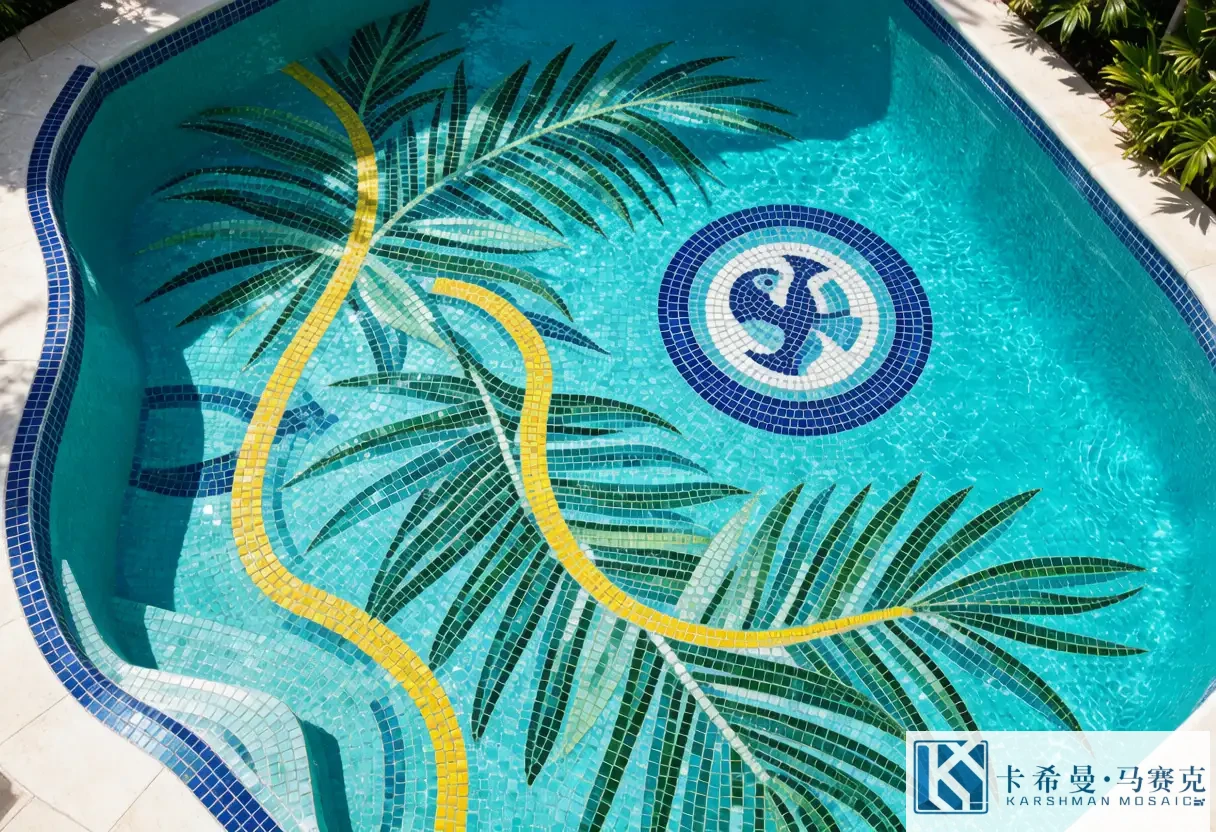
Palm leaves are a staple of tropical pool design. A single frond or a pair of fronds set into the floor or climbing a wall gives an instant tropical read without a busy scene. Palm motifs work as a feature – a large leaf medallion at the pool center – or as a border, where a repeating frond edge frames the water. Because a leaf has a clear outline, it reads well from the deck and keeps its shape underwater better than a detailed creature. Green and aqua tones suit the leaf, with a sand or white background to separate it. A palm is a safe first motif for an owner who wants tropical without a full reef mural.
Tropical fish motifs
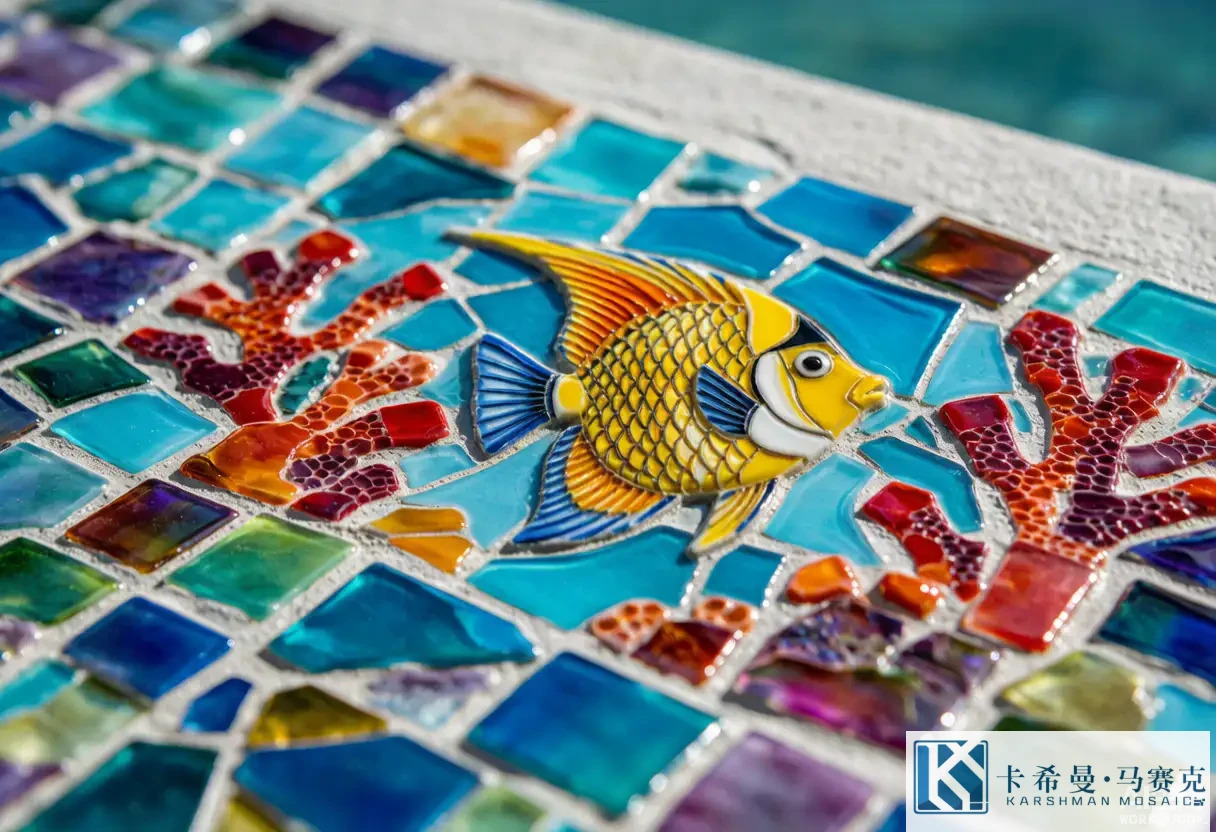
Fish are the other tropical favorite. A single stylized fish, a small school, or a pair facing each other can fill a medallion or run as a repeating border. Fish read clearly because the body shape is simple and the silhouette holds up at depth. Color carries the species feel – a clownfish orange, a blue tang, a yellow tang – without needing fine scales, which blur underwater anyway. A fish motif suits the floor center or a feature wall where swimmers and viewers will see it. Used as a border, a row of small fish adds motion that suggests swimming even before the pool is filled.
Coral and reef motifs
Coral and reef motifs build a small underwater world. A reef scene – branching coral, a fish, maybe a shell – works as a floor mural or a feature wall, and it reads as a destination piece. Coral has an organic shape that suits the small tesserae, and its branching form gives the designer room to play with tone. A reef motif asks for more colors than a single fish, so the planning should keep the palette tight – a few blues and a coral accent – so the scene stays calm. A full reef is a stronger commitment than a lone fish, but it delivers the clearest tropical resort statement for a commercial or showpiece pool.
Shells, hibiscus and botanical accents
Smaller accents round out a tropical scheme. A shell – a conch or a scallop – makes a neat medallion or a border repeat. A hibiscus or a plumeria flower brings the garden into the water and pairs well with a palm. These accents work as the feature while a fish or a reef takes a supporting role, or vice versa. The key is balance: one hero motif plus one or two accents reads designed, while a mix of many subjects across the floor reads scattered. Choosing a leaf, a fish and a flower, then giving each a clear place, is a practical way to build a tropical pool that still looks composed.
Motifs as medallions, borders and fields
Tropical motifs fit the same three-layer model as any pool design. A motif becomes a medallion when placed as the central feature – a fish or a palm at the floor center. It becomes a border when repeated along the waterline or the floor edge – a frond edge or a row of fish. It becomes part of the field when a small repeat fills a larger area, such as a scattered shell pattern across the floor. Treating the motif as a layer keeps the plan manageable: pick one motif for the feature, one for the border, and let the field stay calm. That structure is what stops a tropical pool from turning into a collage.
Combining several motifs
Many tropical pools mix two or three motifs. A common plan is a palm feature, a fish border and a calm field, or a reef feature with a shell border. The combination works when the motifs share a palette and a scale, so they read as one scheme rather than separate stickers. A leaf and a fish in the same aqua-and-coral range sit together naturally; a leaf in green and a fish in a clashing red may not. Keeping the subject count low and the color range shared is the habit that makes a multi-motif pool look intentional. The pool should feel like one tropical place, not a sample board of every available subject.
Color and contrast for tropical motifs
Tropical motifs pop through contrast. A fish in coral against an aqua field separates at a glance; a palm in green against a sand background reads clean. The background tone matters as much as the motif color, because it is what makes the shape visible underwater. A common error is to set a colored motif on a field too close in tone, so the picture disappears at depth. The safe approach is to let the field stay quiet – a single aqua or sand – and spend the color on the motif and the border. That way the tropical subject stays clear from the deck and gains depth as the light moves through the water above it.
Scale and tile size for detail
Scale decides how much detail a tropical motif can carry. Small tesserae, around 20 millimeters or less, let a fish show a fin and an eye, or a palm show a frond split, because the pieces follow tight curves. Larger pieces, near 48 millimeters, read bolder and suit a simple leaf or a single fish where the picture is broad. For a reef scene with several subjects, smaller pieces carry the detail; for a plain palm border, larger pieces are enough and faster to set. The tile size also sets the grout lines, which become part of the motif, so the scale choice shapes the whole look, not just the finesse of one figure.
Reading tropical motifs underwater
Water and light change a tropical motif after build. Depth cools and darkens a tone, so a coral that looks bright dry may read a step deeper once filled. Sun from above adds sparkle to glossy glass; shade keeps tones soft. A motif that looks strong on a dry board can shift once submerged, which is why designers approve a laid sample under water where possible. Planning for the water means choosing values that hold up at depth and a contrast that survives the play of light, rather than trusting a color seen dry on a board. A tropical fish with a clear silhouette and a contrasting background copes with the shift better than a finely shaded scene.
Tropical within the three-layer model
An abstract scheme still fits the field, border and feature model, and so does a tropical one. The field can be a calm aqua or sand that lets the motifs speak. The border can be a frond edge, a row of fish or a shell line rather than a plain band. The feature can be a palm medallion, a reef scene or a single hero fish placed where the eye lands. Treating tropical as the style applied to the same three layers keeps the budget clear and the install clean. A balanced tropical plan is often a calm field, one motif border and one motif feature – enough resort feel without covering every wall in pictures.
Custom tropical art versus stock motifs
Tropical motifs come two ways: stock and custom. Stock motifs – a known palm, a standard fish – are faster and lower risk because the layout is proven and the cost is known. Custom tropical art draws a specific scene or a branded subject for the pool, giving a one-off result but needing drafting, proofing and sign-off. The middle path works well: take a stock palm or fish and place it in a custom color field, or build a small custom reef from stock elements. Deciding early which route you want keeps the timeline and the budget clear before fabrication begins and the glass is committed.
Planning a tropical motif scheme
A practical tropical plan runs in order. Pick the mood – relaxed, lush, playful. Choose one hero motif for the feature and one for the border, keeping the palette shared. Pick a calm field tone that separates the motifs. Choose the tile size by the detail you need. Approve a laid sample of the motif and the border together, viewed in water or under the pool light, before the volume order. A short list like this prevents the common errors – a motif that disappears at depth, a border that fights the shape, a floor crowded with too many subjects – and keeps the pool reading composed once it is full.
Sample approval
Because water changes the read, a dry loose tile is not enough for a tropical motif. Ask for a laid sample of the feature and the border, ideally a small panel set with the planned grout, viewed in water or under the pool light. Check that the motif shape is clear, the color separates from the field, and the border repeats cleanly. For a reef scene, confirm the subjects read in the right order. This sign-off is the cheapest point to adjust color or layout, and it gives both sides a reference if a question arises during the install. Treating the sample as the contract settles most disputes before the tile reaches the site.
Common mistakes to avoid
A few errors repeat across tropical pool jobs. A motif placed off the visual center reads wrong from the deck. A border broken at a corner looks unfinished. Too many subjects across the floor read busy. A motif too close in tone to the field disappears at depth. A scene too fine for the tile size loses its shape underwater. Each of these is avoidable with the planning steps above and a laid sample before the volume order. The discipline costs little at the design stage and protects the look once the pool is full and the surface is fixed for years, which is when a tropical pool should be at its most inviting.
Working with a designer
Whether you brief a designer or a supplier, bring the pool shape, the depth plan and a mood – relaxed, lush, playful. Share references of tropical motifs you like, and name the colors you want to avoid. Ask for a layout drawing and a laid sample before you commit. A good partner will flag a motif that will not read at your depth or a border that fights your shape, and will show you the proof before fabrication. Clear brief plus a physical sample is the combination that turns a set of tropical pictures into a pool that feels like a resort from every angle.
Tropical pool mosaic design builds a resort feel from palm, fish and reef motifs placed as borders, medallions and fields, composed to the pool shape and read through water and light. If you want to plan tropical motifs for your pool, contact our team for layout drawings and laid samples.