
A European villa pool mosaic brings the look of a Mediterranean estate or a French courtyard into a home, hotel or club through layered classical motifs and a blue-and-white palette. Rather than one picture, a villa scheme layers a calm field, a motif border and a feature – a laurel, an urn or a fleur de lis – so the whole surface feels like a place with history, not a single image. The style reads ordered and refined, and it performs well underwater when the motifs have clean lines and the palette stays balanced. This guide explains how to design a European villa pool mosaic, from layering the elements to approving samples, installing and caring for the finished surface.
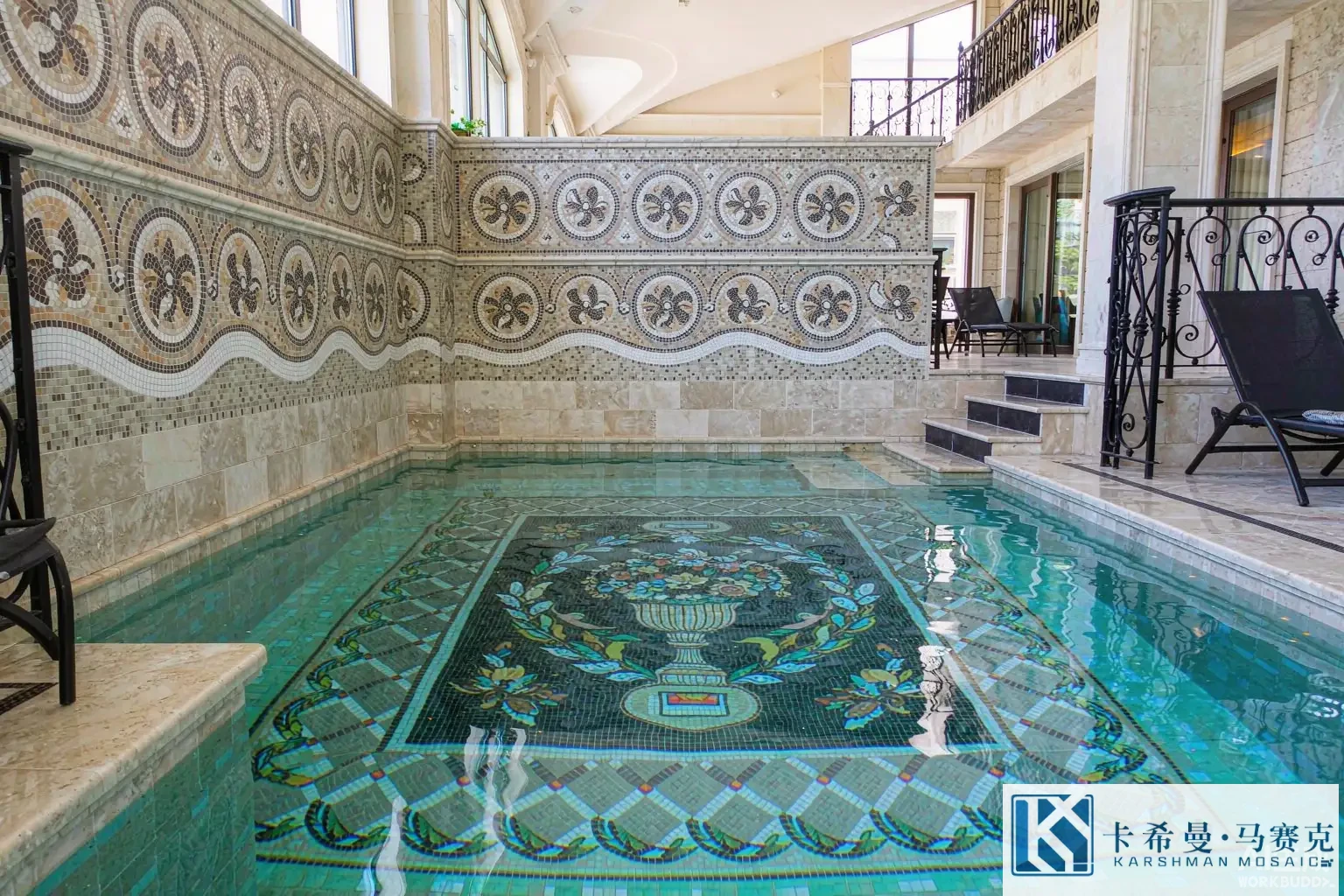
What a European villa pool looks like
A European villa pool reads as a composed retreat rather than a plain blue tank. The field is usually a calm blue or a soft white that suggests Mediterranean water or sunlit stone. The border carries a motif – a meander, a dolphin line or a laurel edge – that frames the water with a classical note. The feature is a stronger moment: a laurel medallion, an urn or a fleur de lis placed on the central axis. The warm accents – terracotta, a touch of slate – appear as highlights against the cool base. The result feels intentional and calm at once, which is the villa character owners are after, and it works as well for a home pool as for a boutique property.
Layering motifs and color
The villa look comes from layering, not from crowding. Start with the calm field as the base. Add one motif border that repeats and frames. Add one feature that acts as the focal point, set on the pool axis. Keep the palette shared – blue and white with a terracotta or slate accent – so the layers read as one scheme. Layering this way means each element supports the next: the field calms, the border frames, the feature draws the eye. A pool that piles motifs without a calm base reads busy instead of villa-like, so the discipline is to let the field do most of the area and the motifs do the moments.
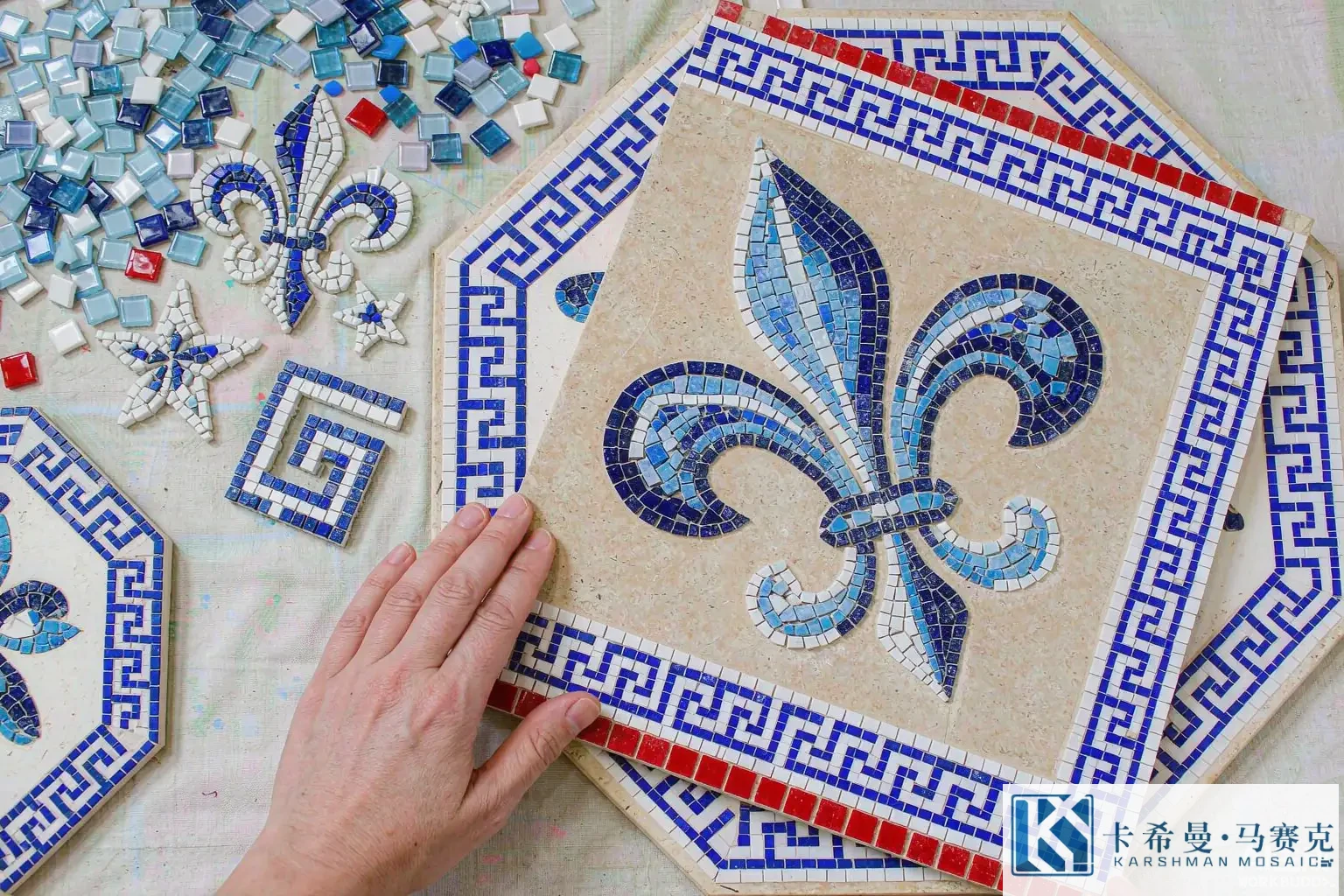
The classical field
The field is the quiet base of a villa scheme. A single blue or a step from blue to a deeper navy toward the deep end gives the water a classical cast without any picture. A white or cream field reads brighter and more courtyard-like, suited to shallow ledges and spas. The field should stay calm so the border and the feature can speak, which also keeps the cost fair because the largest area uses the simplest treatment. A subtle tone step in the field adds interest that reads as designed depth rather than a pattern. Treating the field as a deliberate choice, not the leftover area, is what gives a villa pool its poise and lets the classical motifs land with impact when the eye reaches them.
The classical border
The border is where the villa feel often enters first. A meander, a dolphin row or a laurel edge at the waterline hides the seam between wet and dry tile and gives the water a finished, classical frame. A second border at the floor perimeter can echo it and tie the scheme together. The border tone should relate to the field – a white meander on a blue field, a terracotta line on a navy field – so it frames without fighting. For a freeform pool the border curves with the shape, which is where mesh-mounted sheets earn their keep, and a clean border is what makes a villa pool look designed rather than merely tiled.
The central medallion feature
The feature is the villa centerpiece, and in a European scheme it is usually centered on the main axis. It can be a laurel medallion at the floor center, an urn on a wall, or a fleur de lis placed where the eye lands. The feature carries the warm accents – a terracotta line, a slate detail – and it is where the eye should rest. Because it is the visual center, its placement and alignment matter: centered on a rectangular pool, off-center but balanced on a freeform one. One feature, not three, keeps the pool composed; the border and the field support it, and the warm color spends itself on this one strong moment rather than scattered across the surface.
Combining for a villa feel
A balanced villa plan pairs a calm field, one motif border and one motif feature, all in a shared blue-and-white palette with a warm accent. For example, a blue-to-navy field, a white meander border and a terracotta laurel medallion as the feature reads clearly European and composed. The warm tones stay a minority of the surface, so the pool feels calm rather than loud. The combination works because each layer has a job – base, frame, focal point – and the color plan ties them. Following this structure is what separates a villa pool from a collage of classical stickers, and it keeps the install and the budget predictable.
Materials and finish
Glass is the natural choice for a European villa pool because its body color stays true underwater and its range supports the blue-and-white palette. Glossy glass lifts a shaded pool and adds sparkle that suits a villa; matte glass keeps the tone soft and hides marks in bright sun; iridescent glass shifts color with the angle, enriching a blue or a terracotta accent. For a villa feature, a white meander in gloss reads crisp, while a matte field keeps the ground calm. The finish is part of the color decision, so it belongs in the plan alongside the tones. A sample of each finish on the grid settles the choice, because the same tone can read different in gloss versus matte once the water is in.
Planning steps
A practical villa plan runs in order. Measure the pool and note the shape, the depth changes and the steps. Pick the mood – formal, villa, courtyard, French. Set a cool base field, then a motif border, then one feature placed on the central axis. Choose the warm accents and keep them a minority. Pick the tile size by the detail you need, keeping it consistent. Approve a laid sample of the field, border and feature together, viewed in water or under the pool light, before the volume order. A short list like this prevents the common errors and keeps the pool reading composed once it is full and the surface is fixed for years.
Sample approval
Because water and light change the read, a dry loose tile is not enough for a villa scheme. Ask for a laid sample of the field, the border and the feature, ideally a small panel set with the planned grout, viewed in water or under the pool light. Check that the field stays calm, the border repeats cleanly, and the feature reads with the right contrast and sits centered. For a medallion, confirm the symmetry. This sign-off is the cheapest point to adjust tone or layout, and it gives both sides a reference if a question arises during the install. Treating the sample as the contract settles most disputes before the tile reaches the site.
Installation notes
Installing a villa scheme follows the plan layer by layer. The field sheets are set first as the base, then the border aligns to the waterline and the floor edge, then the feature is centered or placed per the drawing and bedded in adhesive rated for submersion. Movement joints and the waterline are handled so the layers meet flush. Because the feature is often the visual center, its setting has to be true – a tilted medallion or a shifted urn shows at once. A tiler who has set classical mosaic before will protect the alignment and the motifs; asking for that experience is a reasonable step that keeps the finished picture as drawn rather than a near version of it.
Care of a European villa pool
A European villa pool needs no special care beyond the pool routine. Balanced water protects the glass and the grout so the blue and terracotta tones stay true; prompt removal of leaves or debris keeps the surface clear; a soft brush avoids scratching a glossy face. Because the design is fixed in the tile body, there is no pattern to realign and no feature to treat differently. A short care note from the supplier, followed through the season, keeps the colors bright and the motifs sharp for years, which is the quiet payoff of a surface built to sit in the water and carry a classical feel without fine detail to maintain.
Cost factors
A European villa scheme costs more than a plain pool because of the motifs and the warm accents, but it stays manageable with the layered approach. The drivers are the feature size, the tile count, the number of colors and the fineness of the detail. A small laurel medallion in two tones costs far less than a floor-to-wall urn scene in many colors. Mixing a custom or stock feature with a calm field and a simple border keeps the spend focused on the focal point rather than the whole pool. Setting a budget by the feature alone, and letting the field stay simple, is a practical way to get a villa look without spreading the cost across every surface.
Working with a studio
A good studio guides the European brief. Bring the pool shape, the depth plan and a mood, plus references for the motifs and the palette you like. Say what you want to avoid – too busy, too hot, too plain – as clearly as what you want. Ask for the layout drawing and a laid sample before you commit, and review the balance by squinting at the plan. A good partner will flag a motif that will not read at your depth or a border that fights your shape, and will show the proof before fabrication. Clear brief plus a physical sample is the combination that turns a European idea into a pool that feels like a villa from every angle.
Bringing the villa home
A European villa pool is not only for estates. A home pool with a calm blue field, a white meander border and one terracotta laurel feature can carry the same retreat feel in a backyard, and it reads well in photos and in person. The same layering – base, frame, focal point – works at any scale, so the owner can match the spend to the space. Whether the goal is a private courtyard or a boutique property, the principle holds: a calm field, a motif border and one strong feature in a shared palette. That structure is what makes a pool look like a villa rather than a themed tank, and it is the plan worth approving before the tile is ordered.
Designing a European villa pool mosaic layers a calm field, a classical border and one feature in a shared blue-and-white palette for an ordered retreat that reads well underwater. If you want to plan a European villa pool, contact our team for a layout drawing and a laid sample.