
European pool mosaic design brings the feel of a Mediterranean courtyard, a Roman bath or a French garden into the water through a set of classical motifs drawn from architecture and ornament: the Greek key meander, the laurel wreath, dolphins, the fleur de lis, urns and columns. Where a tropical scheme leans on nature and an abstract scheme leans on form, a European scheme leans on order, symmetry and a heritage pattern language that has read as refined for centuries. The style suits villa pools, courtyard pools, boutique hotels and any space where the owner prefers a composed, old-world character over a playful or loud one. This guide walks through the classic European motifs and how they work as borders, medallions and fields in a real pool.
What European pool mosaic means
A European pool mosaic is a scheme built from classical ornament and a restrained palette, usually blue and white with earth-tone accents. The subjects are drawn from Mediterranean and European tradition – geometric borders, foliage swags, sea creatures rendered in a clean line, and architectural elements. The aim is a pool that reads ordered and elegant rather than busy or themed. Because the motifs are often geometric or symmetrical, they rely on precision and repeat more than on fine picture detail, which actually helps them survive underwater, where a loose hand would waver. The planning is about choosing a few strong classical motifs, placing them with symmetry, and letting a calm field carry the rest so the surface feels composed rather than crowded.
The Greek key (meander) border
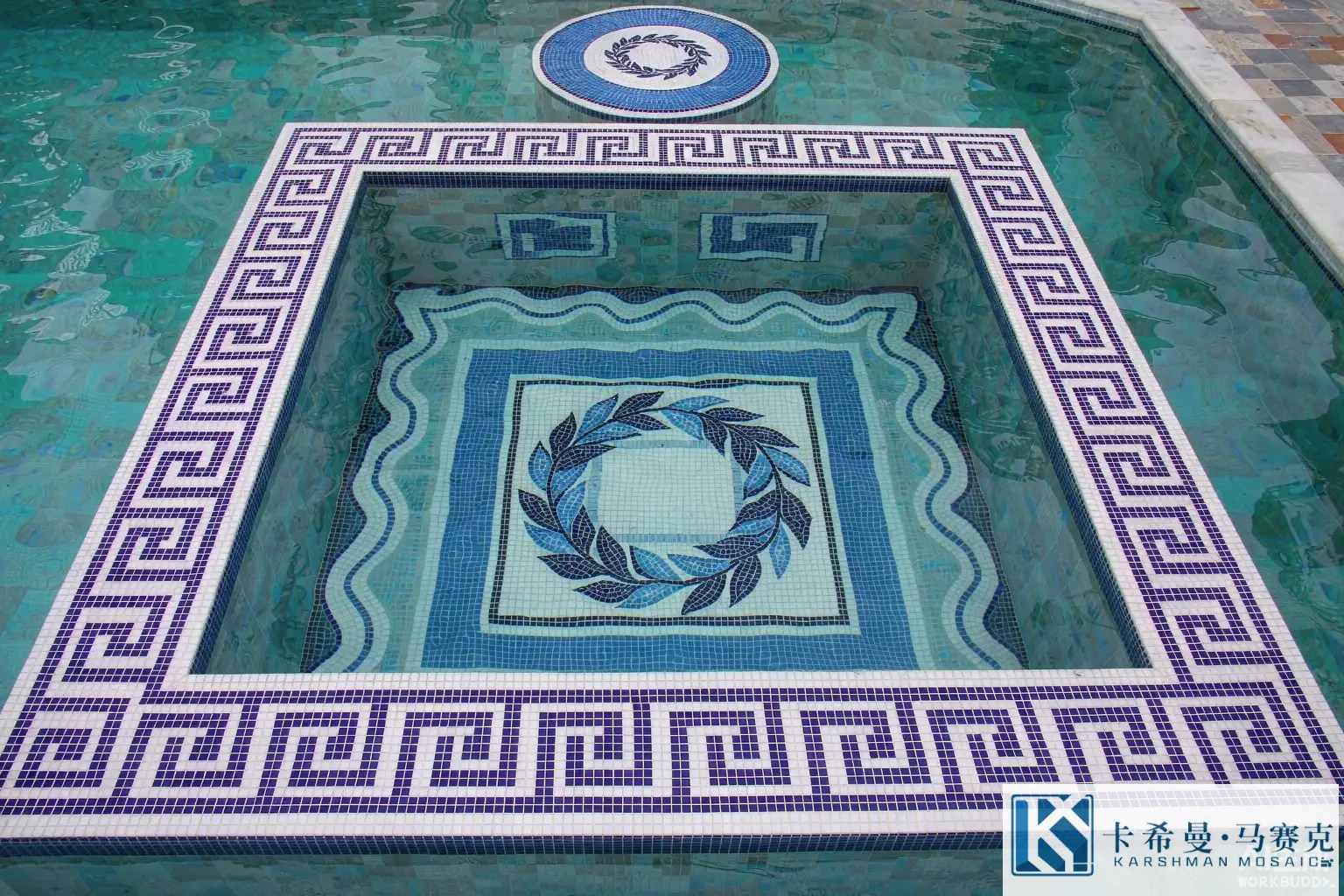
The Greek key, also called the meander, is the signature European pool motif. A continuous line that folds back on itself, it reads as a clean, repeating border that frames the water with an unmistakable classical note. As a waterline or floor-edge border it hides the seam between wet and dry tile and gives the pool an ordered frame. The meander suits glass well because its straight runs and right angles follow the small tesserae without curves that could blur. A single-color meander on a contrasting ground – white on blue, or blue on white – reads crisply from the deck and keeps its shape at depth. It is a safe, proven first motif for an owner who wants European without a figurative scene.

Laurel wreaths and garlands
Laurel wreaths and foliage garlands bring the garden and the classical victory emblem into the pool. A laurel ring set as a floor medallion gives a pool an instant European, almost Roman, character. A garland that runs along a border adds a softer, botanical note than the hard geometry of the meander, pairing well with a villa or courtyard setting. Because a laurel has a clear, repeated leaf shape, it reads well from above and keeps its silhouette underwater. Green and aqua tones suit the leaf, with a white or sand background to separate it. A laurel medallion is a strong feature that still feels calm, which is why it appears across Mediterranean and French classical pools alike.
Dolphins and classical sea creatures
Dolphins are the European sea motif, inherited from Roman and Greek mosaics where they framed fountains and baths. A pair of dolphins facing across a medallion, or a single dolphin arcing along a border, carries the classical water tradition into a modern pool. Dolphins read clearly because the body curve is simple and the silhouette holds at depth. They suit the floor center as a feature or a wall as a relief, and they pair naturally with the meander and the laurel. Used as a border, a row of small dolphins adds a sense of motion that suggests swimming even before the pool is filled. Color is usually a single tone – white, blue or a soft grey – so the line stays clean rather than detailed.
The fleur de lis and French motifs
The fleur de lis brings a French note to the European scheme. As a single emblem set into a medallion, or as a repeating border motif, it reads refined and recognizable without needing a scene. Its three-fold symmetry suits the small tesserae and keeps a crisp shape underwater. A fleur de lis works in blue on white for a classic French look, or in a deeper tone on a pale ground for contrast. It pairs well with a formal, symmetrical pool where order matters more than picturesque detail. For an owner drawn to French garden design, the fleur de lis is a compact way to signal the style without committing to a full figurative mural.
Urns, columns and architecture
Classical architecture – urns, columns, scrolls – gives the European scheme its structure. An urn rendered as a central feature, or a column capital used as a corner motif, ties the pool to the villa or courtyard around it. Scroll and acanthus borders echo the stonework of a terrace, so the pool reads as part of the architecture rather than a separate object. These motifs ask for a steady hand and a clean line, because their appeal is the proportion, not the color. A single urn medallion at the floor center, with a meander border and a calm field, is a composition that has read as elegant for a very long time, and it still does in a contemporary glass build.
Motifs as medallions, borders and fields
European motifs fit the same three-layer model as any pool design, but with an emphasis on the border and the feature working in symmetry. A motif becomes a medallion when set as the central feature – a laurel ring or an urn at the floor center, ideally centered on the pool axis. It becomes a border when repeated along the waterline or the floor edge – a meander, a dolphin row or a fleur de lis line. It becomes part of the field only lightly, because the European look prefers a calm ground that lets the ordered motifs speak. Treating the motif as a layer, and keeping the field quiet, is what stops a European pool from feeling busy and keeps it composed.
Combining classical motifs with restraint
Many European pools mix two or three motifs, but the discipline is restraint. A common plan is a meander border, a laurel medallion and a calm field, or a dolphin border with a fleur de lis feature. The combination works when the motifs share a palette and a scale, so they read as one scheme rather than separate stickers. A meander in white and a laurel in green on a blue field sit together naturally; a meander in one tone and a dolphin in a clashing color may not. Keeping the subject count low and the color range shared is the habit that makes a multi-motif European pool look intentional. The pool should feel like one ordered place, not a sample board of every available classical subject.
Symmetry and the European eye
Symmetry is what gives a European pool its calm authority. A medallion centered on the main pool axis, borders that meet cleanly at the corners, and a field that stays even read as deliberate in a way an off-center or asymmetric layout does not. This does not mean every European pool needs to be a rectangle – a freeform pool can still carry a centered feature and a border that follows the curve – but the sense of balance should hold. Symmetry also helps the motifs survive underwater, because a centered medallion reads true from every angle of the deck, while an off-axis one looks tilted once the water is in and the eye settles on it.
Color and contrast for classical motifs
European motifs read through contrast and a tight palette. A white meander on a blue field separates at a glance; a blue laurel on a white field reads clean. The background tone matters as much as the motif color, because it is what makes the shape visible underwater. A common error is to set a motif on a field too close in tone, so the pattern disappears at depth. The safe approach is to let the field stay quiet – a single blue or a soft white – and spend the contrast on the motif and the border. That way the classical subject stays clear from the deck and gains depth as the light moves through the water above it.
Scale and tile size for detail
Scale decides how fine a European motif can be. Small tesserae, around 20 millimeters or less, let a meander keep its sharp corners and a laurel keep its leaf tips, because the pieces follow tight geometry. Larger pieces, near 48 millimeters, read bolder and suit a plain border or a simple urn where the shape is broad. For a detailed fleur de lis or a dolphin with a fin, smaller pieces carry the line; for a plain meander, larger pieces are enough and faster to set. The tile size also sets the grout lines, which become part of the motif, so the scale choice shapes the whole look, not just the finesse of one figure. A consistent tile size across the scheme keeps the classical line even.
Reading classical motifs underwater
Water and light change a European motif after build. Depth cools and darkens a tone, so a white meander that looks bright dry may read a step softer once filled, and a blue field may read richer. Sun from above adds sparkle to glossy glass; shade keeps tones calm. A motif that looks strong on a dry board can shift once submerged, which is why designers approve a laid sample under water where possible. Planning for the water means choosing values that hold up at depth and a contrast that survives the play of light, rather than trusting a color seen dry on a board. A meander with a clear tonal step and a contrasting ground copes with the shift better than a finely shaded scene.
European within the three-layer model
An abstract or tropical scheme fits the field, border and feature model, and so does a European one. The field can be a calm blue or white that lets the motifs speak. The border is often the star – a meander or a dolphin line rather than a plain band. The feature is a laurel, an urn or a fleur de lis placed where the eye lands, usually on the central axis. Treating European as the style applied to the same three layers keeps the budget clear and the install clean. A balanced European plan is often a calm field, one motif border and one motif feature set with symmetry – enough classical character without covering every wall in ornament.
Custom classical art versus stock motifs
European motifs come two ways: stock and custom. Stock motifs – a known meander, a standard laurel – are faster and lower risk because the layout is proven and the cost is known. Custom classical art draws a specific urn, a bespoke wreath or a family emblem for the pool, giving a one-off result but needing drafting, proofing and sign-off. The middle path works well: take a stock meander and place it in a custom color field, or build a medallion from stock elements arranged to your pool. Deciding early which route you want keeps the timeline and the budget clear before fabrication begins and the glass is committed.
Planning a European motif scheme
A practical European plan runs in order. Pick the mood – formal, villa, courtyard, French. Choose one hero motif for the feature and one for the border, keeping the palette shared and the layout symmetric. Pick a calm field tone that separates the motifs. Choose the tile size by the detail you need, keeping it consistent. Approve a laid sample of the motif and the border together, viewed in water or under the pool light, before the volume order. A short list like this prevents the common errors – a motif that disappears at depth, a border that fights the shape, a floor crowded with too many subjects – and keeps the pool reading composed once it is full.
Sample approval
Because water changes the read, a dry loose tile is not enough for a European motif. Ask for a laid sample of the feature and the border, ideally a small panel set with the planned grout, viewed in water or under the pool light. Check that the motif shape is clear, the color separates from the field, and the border repeats cleanly around a corner. For a medallion, confirm it sits centered and symmetric. This sign-off is the cheapest point to adjust color or layout, and it gives both sides a reference if a question arises during the install. Treating the sample as the contract settles most disputes before the tile reaches the site.
Common mistakes to avoid
A few errors repeat across European pool jobs. A medallion placed off the central axis reads tilted from the deck. A border broken at a corner looks unfinished. Too many classical subjects across the floor read busy. A motif too close in tone to the field disappears at depth. A meander too fine for the tile size loses its corners underwater. Each of these is avoidable with the planning steps above and a laid sample before the volume order. The discipline costs little at the design stage and protects the look once the pool is full and the surface is fixed for years, which is when a European pool should be at its most composed.
Working with a designer
Whether you brief a designer or a supplier, bring the pool shape, the depth plan and a mood – formal, villa, courtyard, French. Share references of classical motifs you like, and name the colors you want to avoid. Ask for a layout drawing and a laid sample before you commit. A good partner will flag a motif that will not read at your depth or a border that fights your shape, and will show you the proof before fabrication. Clear brief plus a physical sample is the combination that turns a set of classical lines into a pool that feels European from every angle.
European pool mosaic design builds a classical character from Greek key, laurel, dolphins and fleur de lis placed as borders, medallions and fields, composed with symmetry to the pool shape and read through water and light. If you want to plan European motifs for your pool, contact our team for layout drawings and laid samples.