
Small rooms challenge designers to do more with less. Mosaic tiles, with their scale and reflective options, are a useful tool for making compact bathrooms and kitchens feel open and considered. The ideas below help you get a from a limited footprint.
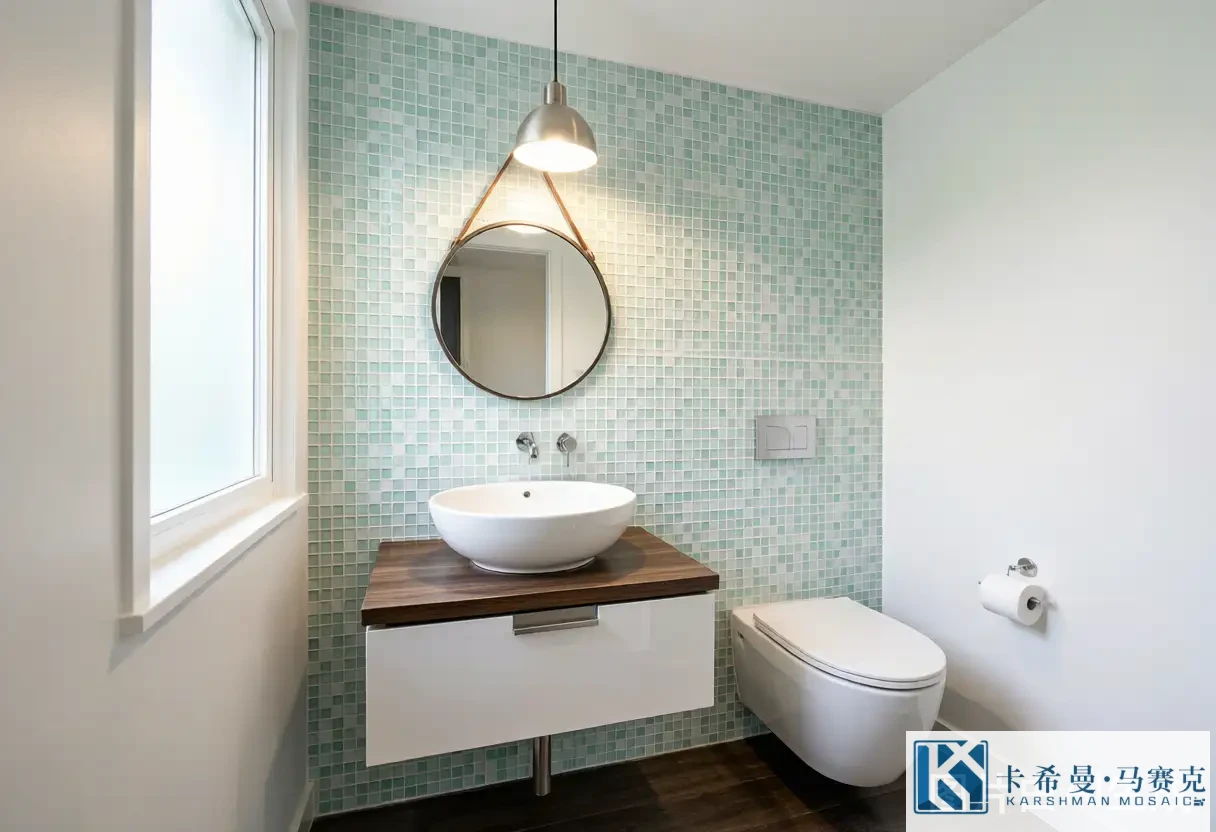
Light Colors Open Up a Room
Pale tiles reflect more light and visually expand a wall. Whites, soft aquas, and warm beiges are sensible starting points in a small bathroom or powder room. A single light-toned mosaic wall can brighten the whole space without overwhelming it, and it pairs well with plain painted surfaces elsewhere.
Vertical and Diagonal Layouts
The direction of the pattern guides the eye. A vertical stack draws the eye upward and adds height to a low ceiling. A diagonal or herringbone run adds movement and can make a narrow wall feel wider. Experiment with sheet orientation on a sample board before committing, because the same tile can read quite differently in each direction.
Feature Walls vs Full Coverage
In a tiny room, covering every surface with busy tile can feel cramped. A common approach is one mosaic feature wall behind the sink or vanity, paired with plain painted walls elsewhere. This adds interest while keeping the room calm. Save full mosaic coverage for a single statement area, such as a shower niche or a backsplash strip.
Reflective Glass for Depth
Glass mosaic tiles add a sense of depth because they catch and return light. In a small space, a glass accent wall can make the room feel larger than its footprint. Pair glass with good task lighting to amplify the effect, and keep the surrounding finishes simple so the tile remains the focal point.
Grout Color Matters
Grout lines shape the final look. A grout close to the tile color blends the surface into a smooth field, which reads as larger and cleaner. A contrasting grout highlights the grid and adds graphic detail but can make a wall feel busier. For small spaces, a tonal grout is often the calmer choice and is easier to keep looking neat.
Pattern Scale
Smaller tile chips create more grout lines and a finer texture, which can suit detailed or curved areas. Larger chips feel more modern and less busy across a flat wall. Match the chip scale to the room’s proportions—finer mosaics suit very small niches, while larger chips suit open walls and keep the eye moving smoothly.
Final Thoughts
With light colors, a considered layout, and one well-placed feature, mosaic tiles can turn a compact room into a space that feels intentional and roomy. Start with a sample board and view it under your lighting before ordering. Need help planning a small-space mosaic? Reach out on our contact page for tailored suggestions.